Anna has taught probability and stochastic processes, signals and systems, and communication theory at the undergraduate and graduate level, and has introduced graduate courses in machine learning and in modern power system operations — demand response, renewable integration and cyber-physical security. Class sizes have ranged up to 280 students.
Currently teaching at Cornell Tech
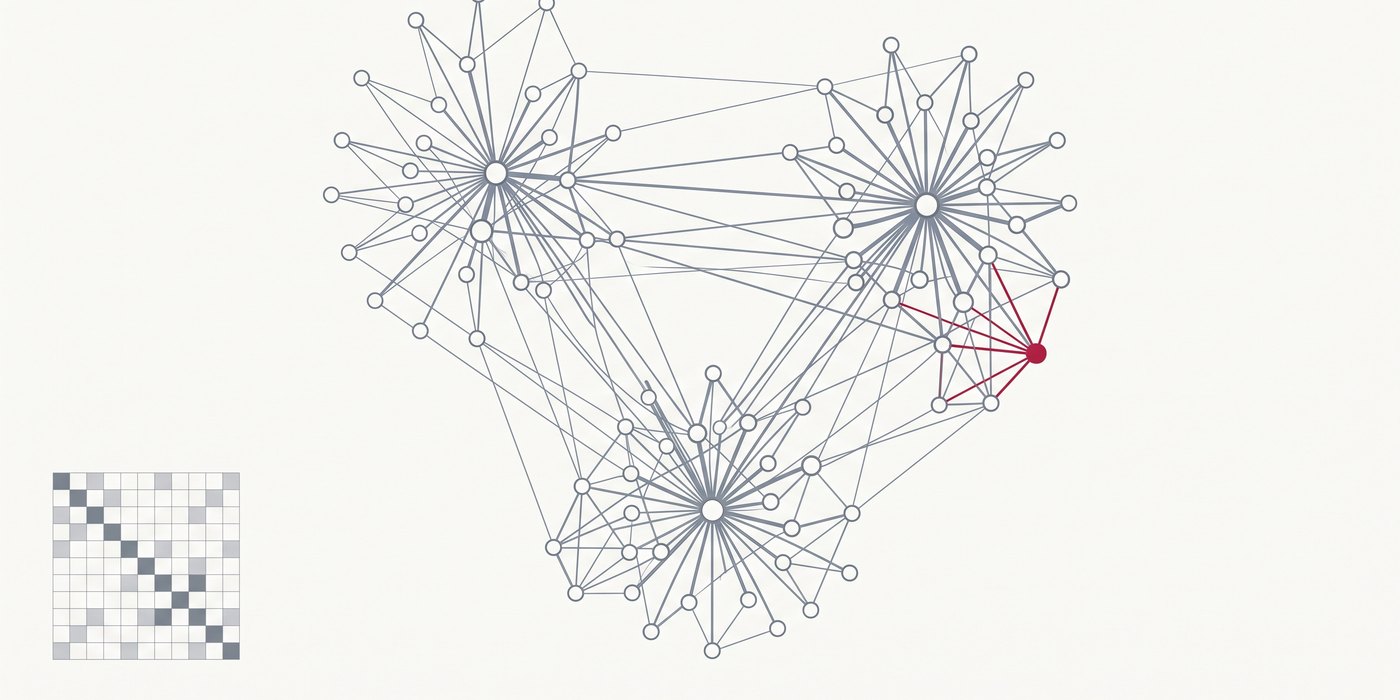
Graph-Based Data Science for Networked Systems
The mathematics of networks and the data science built on it: graph algebra, incidence and Laplacian matrices, partitioning and centrality, random graph models, and dynamics on networks — consensus, epidemics and flows — through to modern graph learning: graph signal processing, graph convolutional networks, graph transformers and graphical models, applied to social, biological, financial and infrastructure networks.
Lecture slides — Spring 2026 (25 decks)
 Notes
Notes
 Lecture 1 · Introduction
 Lecture 2 · Graph topologies and characteristics
 Lecture 3 · The algebra of network graphs
 Lecture 4 · The incidence matrix
 Lecture 5 · The Laplacian Matrix
 Lecture 6 · Graph Partion - centrality
 Lecture 7 · Centrality - node features
 Lecture 8 · More features - random graphs
 Lecture 9 · Random Graph Models and Real Networks
 Lecture 10 · Random Graph models and real networks
 Lecture 11 · Random walk consensus
 Lecture 12 · Epidemic
 Lecture 13 · General dynamics -flow networks
 Lecture 14 · _social-new
 Lecture 15 · Biological
 Lecture 16 · _financial_collaboration
 Lecture 17 · _infrastutures
 Lecture 18 · _NetworkEmbedding-Shallow
 Lecture 19 · _GSPintroduction
 Lecture 20 · _algGSP-Shallow-methods
 Lecture 21 · _ChebyshevGCN
 Lecture 22 · _GNNApplications
 Lecture 23 · _Graph_Transformers
 Lecture 24 · _Graphical Models
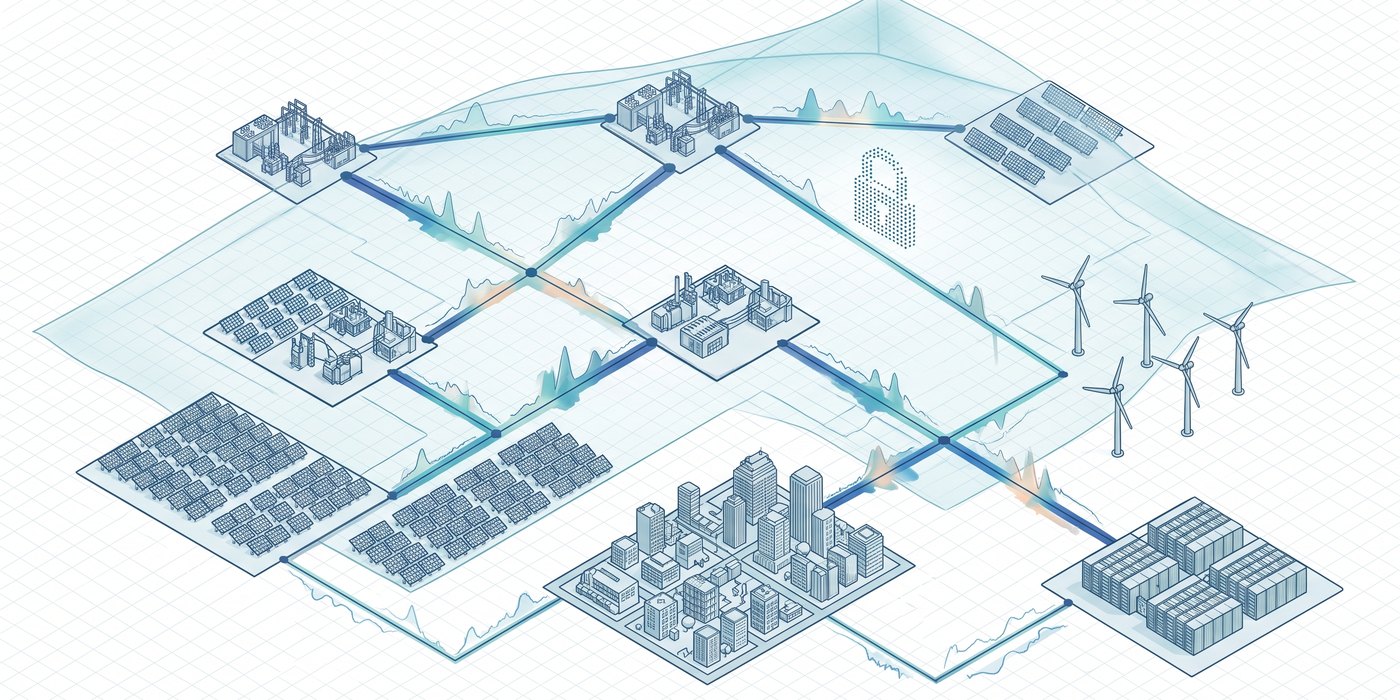
Sustainable Urban and Energy Delivery Systems
The operation of the electric power system, from physics and system theory through to markets: power flow and optimal power flow, state estimation, three-phase distribution network modeling, energy markets and locational marginal pricing, flexible demand and demand response, forecasting, and machine learning for grid inference.
Beyond the classroom

The World's Most Important Machine Has Trust and Decision Issues
A public talk at the Pint of Science festival on the electric grid: why keeping it running is a problem of trust, and of decisions taken continuously across a continent. Anna's own summary of it — “a 3,000-mile-wide panic attack keeping your lights on.”
How Do We Teach Signal Processing Courses in the Era of AI?
A panel on what AI does to signal processing teaching — using the tools in class, rethinking assessment, and what students now need to graduate with. With Al Bovik, Edward J. Delp, Sharon Gannot, Aggelos K. Katsaggelos, Andreas Spanias, and moderators Marios S. Pattichis and Andres Kwasinski. The written account of these roundtables appeared in IEEE Signal Processing Magazine in 2026.
WeCREATE Inspiration Session
One of three speakers at the first WeCREATE Inspiration Session, presenting alongside Cheng Zhang (Microsoft Research) and Setareh Maghsudi (University of Tübingen), hosted by Mihaela van der Schaar. WeCREATE is a van der Schaar Lab initiative that encourages women students and early-career researchers towards machine learning and AI.
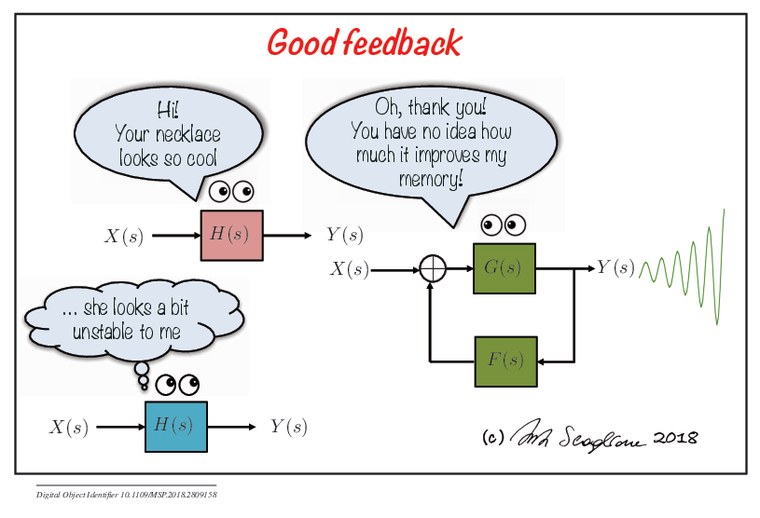
Cartoons for IEEE Signal Processing Magazine
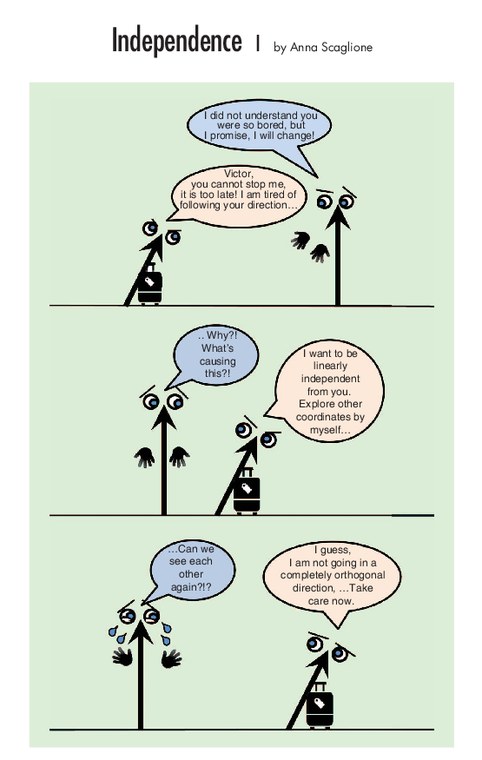
Three strips drawn for the magazine's humor page, each a joke that only works if you know the mathematics: a feedback loop whose necklace improves her memory but leaves her looking unstable; two vectors breaking up because one wants to be linearly independent; and a tube of toothpaste promising E[(Ux)(Ux)T] = I, with PCA inside.

Information in Small Bits
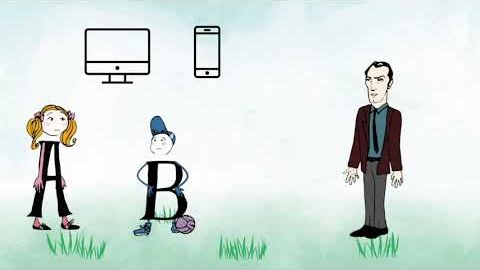
A book that explains information theory through story and pictures. It began as a joke: Anna drew each story as an 8×11 pencil sketch and sent the cartoons to Christina Fragouli, who was serving on the committee choosing narratives to celebrate the Claude Shannon centennial — an effort aimed at teenagers. Christina thought the cartoons had value, and wrote the educational explanations that accompany the drawings. The IEEE Information Theory Society published the result as a non-profit outreach project.
The mathematics under the drawings is exact, and the jokes reward a reader who already knows it: when B steps onto the scale, the weight it reads is the information carried by the letter B in the English alphabet. Catching that takes a fairly mature reader — the pictures never give it away.
Previously taught
Arizona State University — EEE 598 Bayesian Methods in Machine Learning; EEE 598 Demand Response and Renewable
Integration; EEE 455 Communication Systems; EEE 554 Random Signals; EEE 552 Digital Communications; EEE 350 Random
Signal Analysis.
University of California, Davis — EEC 289 SmartGrid Networks; EEC 289 Mobile Communications; EEC 265 Digital
Communications; EEC 260 Random Signals and Noise; EEC 161 Probability; ENG 06 Engineering Problem Solving.
Cornell University, Ithaca — ECE 567 Digital Communications; ECE 568 Mobile Communications; ECE 468
Telecommunication Systems II; ECE 411 Random Signals in Communications and Signal Processing; ECE 220 Signals and
Systems; ENGRG 150 Freshman Advising Seminar.
University of New Mexico — EE 595-091 Digital Communications; EE 595-011 Spread Spectrum Communications.
University of Minnesota — EE 3025 Statistical Methods in Electrical and Computer Engineering.